
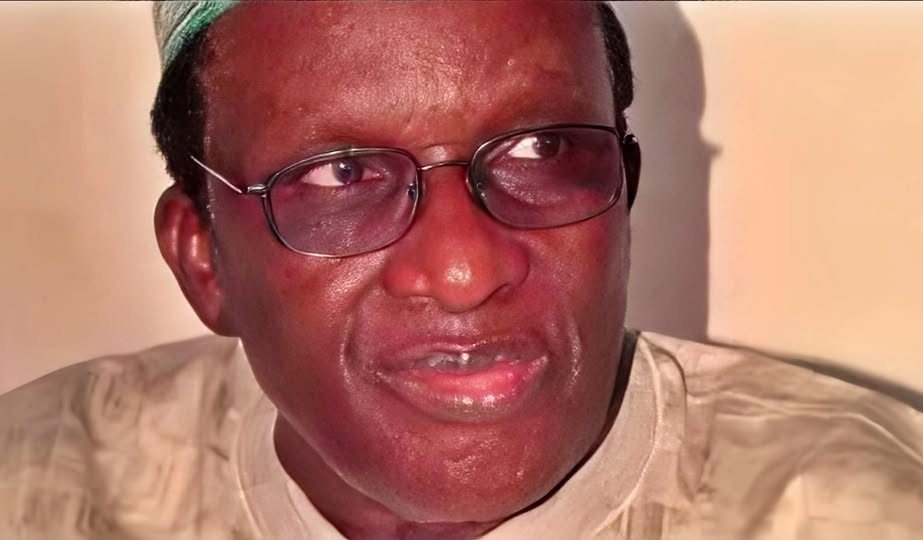


The Gambia awoke today to a silence that feels heavier than grief itself. A towering figure has departed our midst. Lawyer Ousman Sillah, legal luminary, survivor of tyranny, scholar of rare brilliance, and one of the bravest sons this nation has ever produced, has returned to his Lord.
His passing is not merely the loss of a man; it is the dimming of a moral lighthouse that guided a generation through some of the darkest chapters of our national life. As the Qur’an reminds us, “Every soul shall taste death, and you will only be given your full reward on the Day of Resurrection.” His journey on this earth has ended, but his reward with his Lord has only begun.
In the story of every republic, there emerge individuals whose lives transcend the ordinary boundaries of service. They do not simply practice their profession; they elevate it into a form of national stewardship. They do not merely resist oppression; they expose its fragility. They do not simply survive injustice; they transform their suffering into a testament of principle. Lawyer Ousman Sillah belonged to this rare and sacred category.
His life was a living argument for courage. His intellect was a force that shaped jurisprudence. His resilience was a rebuke to tyranny. He lived the Qur’anic injunction: “Stand firmly for justice, even against yourselves or your kin.”
Long before he became one of the country’s most formidable legal minds, Sillah had already demonstrated the leadership and discipline that would define his life. As a “School Boy International,” he represented The Gambia in football and captained the national team to its last victory over Senegal. This early chapter revealed a young man of exceptional talent, strategic thinking, and quiet determination. Yet even this achievement would pale in comparison to the brilliance he later brought to the law.
His academic journey was itself extraordinary. Beginning as a science student, he earned a degree in Mathematics and Physics—fields that demand precision, discipline, and analytical rigor. But his intellectual curiosity was too expansive to be confined to one discipline. He turned to the study of law, where he would eventually distinguish himself as one of the most gifted defense advocates in Gambian history. The fusion of scientific reasoning and legal mastery made him a rare mind—methodical yet imaginative, rigorous yet humane.
It was in the courtroom, however, that Lawyer Sillah’s courage was most severely tested. During the authoritarian era of Yahya Jammeh, he defended Baba Jobe in a case that placed him squarely in the crosshairs of state-sponsored violence. For upholding the ethics of his profession—for insisting that even the unpopular deserved due process—he became a target of the Junglers, Jammeh’s notorious hit squad.
In December 2003, they attempted to assassinate him. The bullets that tore through his body were meant to silence him forever. Instead, they immortalized him.
He survived the attack with grave injuries, losing a kidney and bearing permanent facial wounds. Yet even in the aftermath of this brutality, his spirit remained unbroken. Speaking from his hospital bed in Dakar, he thanked God for sparing his life. There was no bitterness in his voice, only humility and resolve. His survival was not just a personal triumph; it was a victory for the ideals he embodied—justice, fairness, and the unyielding belief that truth is worth any sacrifice. His gratitude echoed the Qur’anic reminder: “If you are grateful, I will surely increase you.” And indeed, God increased him in wisdom, in dignity, in legacy.
Beyond the courtroom, Lawyer Sillah was a scholar, a policy thinker, and a public intellectual whose insights shaped national discourse. His mastery of constitutional law was unmatched. His arguments were not merely persuasive; they were principled. His advocacy was not merely technical; it was anchored in justice. In a country still struggling to consolidate democratic norms, he stood as a moral compass, reminding us that the rule of law is not a slogan but a sacred obligation. He lived by the Qur’anic ethic that “God commands justice, excellence, and compassion.”
His leadership extended into human rights advocacy. As Chairman of the Coalition of Human Rights Defenders, he played a pivotal role in challenging the unconstitutionality of repressive laws, including the draconian National Media Commission. I was privileged to work alongside him in that struggle. Our friendship deepened during his years in exile in North Carolina while I was at Harvard. Facilitating his Human Rights Fellowship at Harvard Law School remains one of the most meaningful contributions I have made to our shared mission for justice and dignity. He deserved every platform where truth was honored.
Yet behind the brilliance and courage was a man of profound humanity. A devoted Muslim of the Tijaniyya order, he carried his faith with quiet dignity. His humor, humility, and warmth endeared him to all who knew him. He listened deeply, spoke thoughtfully, and uplifted others effortlessly. He was a man who could debate constitutional law with razor-sharp precision and, moments later, share a joke that dissolved the heaviness of the world. His character reflected the Qur’anic description of the servants of the Most Merciful: “Those who walk upon the earth with humility.”
The life of Lawyer Ousman Sillah invites comparison to global icons who stood for justice under perilous conditions—figures like Nelson Mandela and Justice Aharon Barak. Like them, he understood that the pursuit of justice is not safe, not easy, and not glamorous. It is sacrificial. It is lonely. It is holy. His life reminds us that the defenders of truth often pay the highest price, yet their legacy outlives the fear that sought to silence them. His journey affirms the Qur’anic truth that “Falsehood is bound to perish, while truth stands clear.”
Today, as we mourn him, we must also confront the responsibility his legacy imposes on us. He leaves behind a standard of courage that challenges complacency. He leaves behind a model of integrity that rebukes opportunism. He leaves behind a vision of justice that demands guardianship. His life was a summons to moral clarity, and his death is a call to continue the work he began.
To my friend, my brother in the struggle, my intellectual companion, your journey on this earth has ended, but your light remains. May history honor you as one of The Gambia’s finest sons, a man who stood unflinchingly for justice when it was dangerous to do so.
May your courage inspire generations yet unborn. May your name be etched where the nation keeps its sacred memories. And may the Most Merciful envelop you in His boundless compassion, for “Indeed, to God we belong, and to Him we shall return.”
Rest in power, Lawyer Ousman Sillah. Your life was a testimony. Your death is a reminder. Your legacy is eternal. May Allah grant you Alijannah Firdausi.