

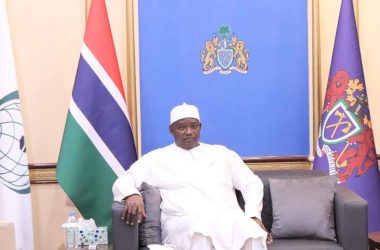
President Adama Barrow has hailed the Senegambia Bridge as one of The Gambia’s greatest infrastructure success stories, saying the landmark project demonstrates the transformative impact of strong regional partnerships and development financing.
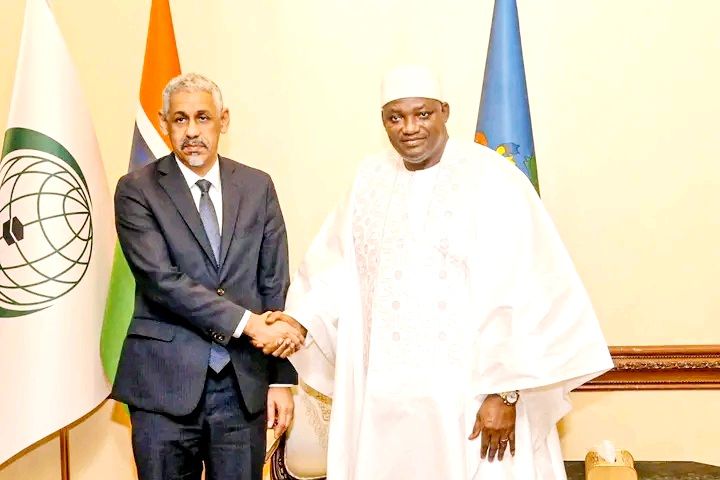
Speaking at the State House in Banjul during a courtesy visit by a high-level delegation from the African Development Bank (AfDB), led by its President, Dr. Sidi Ould Tah, Barrow described the delegation’s presence as a vote of confidence in his administration and expressed optimism about strengthening cooperation with the continental lender.
The President said the Senegambia Bridge has become a critical economic corridor for West Africa, facilitating trade and improving regional connectivity.
“Seventy-five percent of the vehicles using the bridge are subregional, connecting people who are trading across borders,” President Barrow said.
He added that the introduction of 24-hour operations at the bridge has significantly boosted economic activity, accelerated cross-border trade, and improved access to essential social services.
Despite the progress, Barrow warned that The Gambia faces a daunting infrastructure challenge that cannot be addressed through conventional financing alone. He called for innovative funding mechanisms to bridge the country’s estimated 5,000-kilometre road deficit.
“We have to be innovative in raising funds,” the President said. “If it took two previous governments over 30 years to mobilise funds for the Senegambia Bridge and about 100 kilometres of road, how long will it take us to fund the 5,000 kilometres of road we need?”
Barrow reiterated that infrastructure development remains at the heart of his government’s development agenda, arguing that investments in roads, electricity and public services have already delivered tangible benefits across the country.
According to the President, improved infrastructure has contributed to increased student enrolment at the University of The Gambia, expanded access to healthcare services, and extended electricity and road networks to rural communities that were previously isolated.
For his part, AfDB President Dr. Sidi Ould Tah reaffirmed the bank’s commitment to supporting The Gambia’s development priorities. He assured President Barrow that the African Development Bank Group would continue working closely with the government to improve the lives and livelihoods of Gambians through strategic investments.
The meeting also touched on preparations for the upcoming African Caucus meeting, which The Gambia is set to host later this year. President Barrow said the country is ready to welcome delegates to what he described as a prestigious continental gathering.
He attributed The Gambia’s growing capacity to host major international events to sustained economic progress, supported by tax reforms, digitalisation initiatives and improved public sector management.
Concluding the meeting, President Barrow thanked Dr. Tah and the African Development Bank for their continued partnership, saying The Gambia’s political stability, independent judiciary, democratic governance and improving business climate position the country as an attractive destination for international investment.