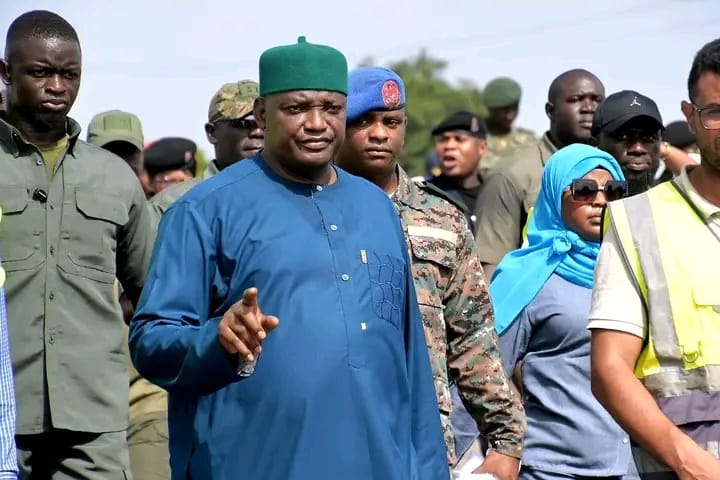

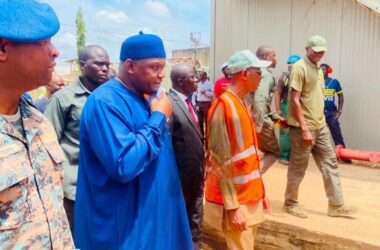
President Adama Barrow has defended his administration’s major infrastructure projects, saying the Sukuta-Jabang overpass and Kotu Bridge are responses to longstanding public demands and investments designed to meet Gambia’s future needs.
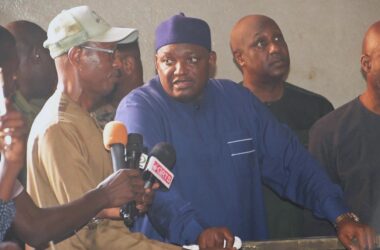
The President made the remarks while speaking to reporters during an inspection tour of the two projects, which have attracted public criticism over traffic congestion, construction delays, costs and the disruption caused to motorists and surrounding communities.
The Sukuta-Jabang junction, being upgraded under Phase Three of the Organisation of Islamic Cooperation (OIC)-funded road network, has been particularly affected by severe traffic bottlenecks during construction.
President Barrow acknowledged the widespread criticism surrounding the project, saying the concerns raised by motorists and members of the public had influenced the government’s decision to pursue the overpass.
“All the comments, definitely on this road, the negative comments were all directed to this Sukuta-Jambur roundabout,” Barrow said.
He acknowledged that constructing a bridge was not an easy decision but said the government had listened to public concerns and acted accordingly.
“It was not a very easy decision though, because it’s not easy to build bridges. But because of that, government, we are very good listeners. We listen to our people, and we want to do what the people want,” he said.
The President also rejected suggestions that the overpass was an unnecessary expenditure, arguing that the persistent congestion at the junction had made intervention unavoidable.
According to Barrow, motorists previously spent so much time caught in traffic at the roundabout that the delay could exceed the time required to travel the entire distance from Banjul.
He nevertheless acknowledged the difficulties experienced by commuters during construction, including dust, delays and prolonged traffic disruption, and apologised to those affected.
“If it affects anybody, we apologise. That is not our wish,” Barrow said. “Development also sometimes goes with challenges. The challenges are the dust that we have been encountering during the project, and the delays, the inconveniences.”
Barrow Defends Kotu Bridge Investment
The President also defended the construction of the Kotu Bridge, another major infrastructure project that has come under scrutiny over its cost and necessity.
Barrow said the bridge was particularly important because of its location within one of The Gambia’s major tourism and commercial corridors, arguing that improved infrastructure would support economic activity, create employment opportunities and enhance road safety.
He said the previous road alignment was unsafe and poorly designed, making a comprehensive redesign necessary.
The President maintained that government spending on the two projects represents a long-term investment rather than expenditure intended to address immediate needs alone.
He further sought to reassure the public about the quality and durability of the structures, saying both projects were designed with a 100-year guarantee.
“We are not building for today, but we are building for tomorrow,” Barrow said, stressing that quality would not be compromised.
“We don’t want the next person who is coming to do what we are doing. Quality, we don’t compromise quality.”
Sukuta Overpass Targeted for October Opening
The government says the Sukuta overpass is currently about 90 percent complete and is expected to open to traffic by the end of October.
The Kotu Bridge is expected to follow, with completion and opening targeted between late October and November.
The projects have become highly visible symbols of the Barrow administration’s infrastructure programme, while also generating debate over public spending, construction timelines and the disruption associated with major road works.
With both structures nearing completion, attention is now turning to whether the projects will deliver the improvements in traffic flow, safety and connectivity promised by the government.
For the Barrow administration, however, the projects represent more than immediate solutions to congestion. The President says they are part of a broader effort to build infrastructure capable of serving future generations.