
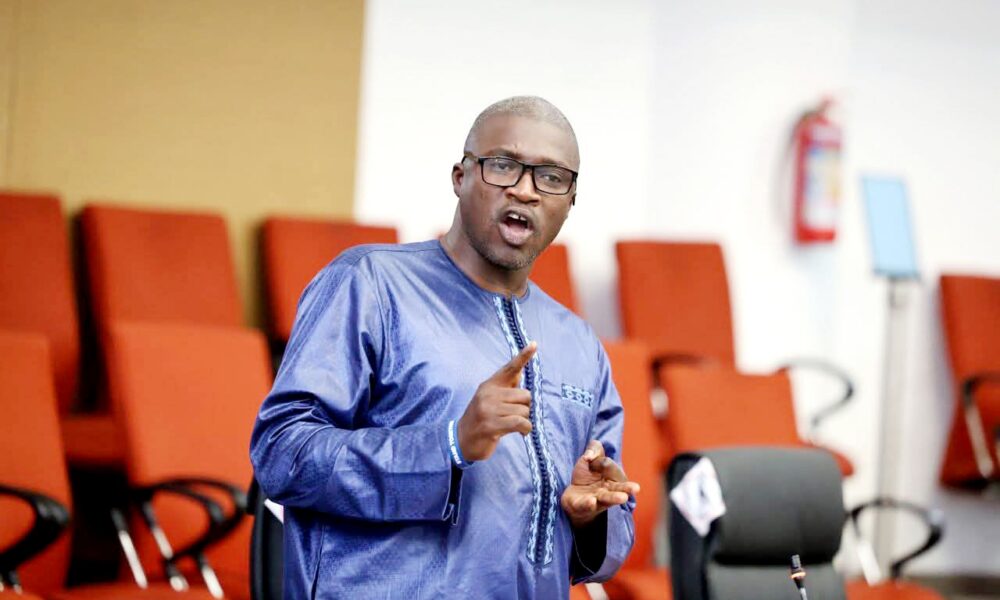


The National Assembly Member (NAM) for Latrikunda Sabiji, Hon. Yaya Menteng Sanyang, has expressed concern over the academic and professional qualifications of some lawmakers, warning that inadequate capacity within the legislature undermines effective parliamentary oversight and accountability.
Speaking during a social contract signing ceremony at the Bakadaji Hotel in Kololi, Hon. Sanyang called on Gambians to prioritise competence and professional qualifications when electing National Assembly members.
The event brought together youth groups, civil society organisations, politicians and media practitioners to discuss governance, accountability and civic participation.
According to the Latrikunda Sabiji lawmaker, the effectiveness of Parliament largely depends on the competence of those entrusted with representing the people.
“Moving forward, Gambians should make sure, if you are voting for an individual who’s going to be a National Assembly member, that they have capacity,” Sanyang said. “At least, let them be a professional in an area either a qualified teacher, a qualified nurse, or a qualified community service personnel.”
He argued that electing representatives without adequate education or professional expertise remains one of the country’s major governance challenges.
To illustrate his point, Sanyang cited the work of the National Assembly’s Public Accounts Committee (PAC), which is responsible for scrutinising government spending and ensuring financial accountability.
“Now that National Assembly members sit on the Public Accounts Committee, if you don’t even know what a balance sheet is, and you want to evaluate a Permanent Secretary responsible for economy and finance, what question are you going to ask them?” he asked.
“You want to call heads of parastatals managing millions of dalasis, what are you going to ask them?”
The lawmaker argued that when public officials recognise that lawmakers lack the technical knowledge to effectively question them, parliamentary oversight becomes significantly weakened.
He further claimed that ministers and permanent secretaries often appear before the Assembly confident that they possess greater technical expertise than some legislators assigned to scrutinise their work.
Sanyang urged young people to champion the election of capable representatives, saying institutional competence is essential for strengthening democratic governance.
“The youth should advocate for capacity National Assembly members with capacity to go to the National Assembly and serve them,” he said.
Addressing citizen engagement, Sanyang acknowledged the importance of regular town hall meetings but lamented what he described as widespread public apathy toward governance issues.
Reflecting on his tenure, he said he established a constituency development office to facilitate dialogue with residents. Although attendance was initially encouraging, participation declined over time.
“The difficulty of holding town meetings is that citizens themselves are very disinterested,” he said, suggesting that early attendance was often motivated by expectations of immediate material benefits rather than sustained civic engagement.

He added that public disengagement extends to parliamentary proceedings, noting that many citizens are unaware of debates and decisions taking place in the National Assembly.
“Citizens don’t even know what is happening in the National Assembly. If you want to take an extra step to want to know what is happening… they are disinterested,” Sanyang said.
He concluded by calling for renewed commitment from both elected representatives and citizens to strengthen democratic participation, accountability and effective governance.