
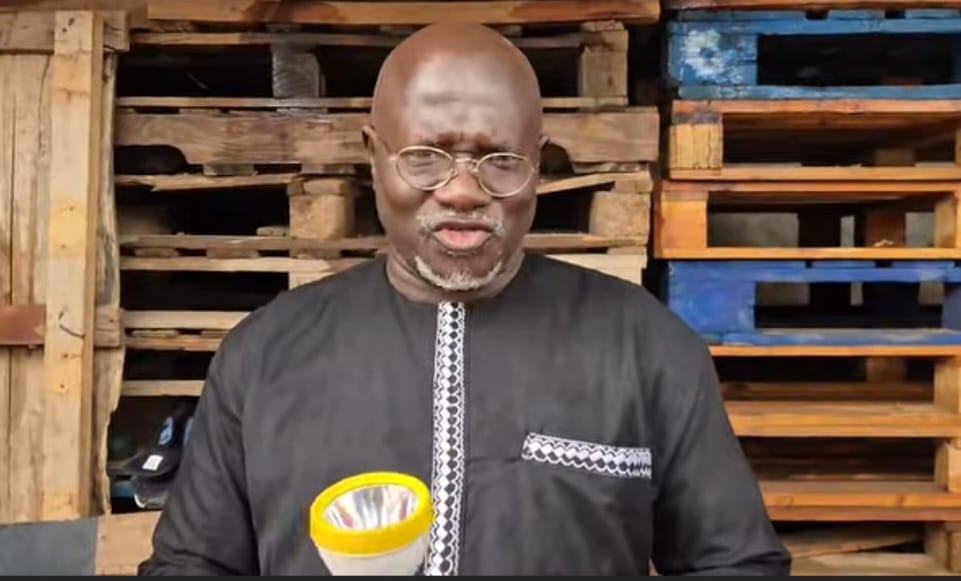



Prominent Gambian human rights activist Madi Jobarteh has sharply criticised the government’s handling of the country’s ongoing electricity and water crisis, describing the situation as a failure of governance, leadership, and management rather than a technical or weather-related problem.
Speaking on Friday at a protest organized by Gambians Against Looted Assets (GaLa), Jobarteh urged citizens from all sectors of society to hold authorities accountable for the prolonged outages affecting communities across the country.
Despite heavy rainfall during the demonstration, Jobarteh dismissed suggestions that bad weather should discourage civic participation or be used as an excuse for government shortcomings.
“Rain is part of our society, our nature, our culture, so it should not make us lose our responsibilities,” he said. “I call on everyone to come out teachers, doctors, civil servants, security officers, politicians, businesspeople, activists, journalists, fathers, mothers, husbands and wives. This rain is not supposed to stop us; it is part of our lives.”
Jobarteh argued that the challenges facing the National Water and Electricity Company (NAWEC) require active public engagement and long-term reforms rather than silence and inaction.
He also questioned the government’s reliance on imported electricity and temporary energy arrangements, warning that sustainable energy security can only be achieved through stronger domestic generation capacity.
“We are relying on foreign sources until and unless we handle the internal domestic generation of electricity,” he said. “What we need is to build our domestic generation, and that capacity is there.”
The activist further raised concerns about the billions of dalasis invested in the energy sector over the past decade. According to Jobarteh, more than D40 billion has been allocated to energy projects between 2017 and 2026, yet electricity generation remains far below national demand.
He cited operational challenges at major power stations, claiming that facilities with installed capacities of between 40 and 45 megawatts are often producing only around 10 megawatts. National electricity generation, he said, frequently falls between 10 and 20 megawatts despite demand exceeding 100 megawatts.
“How come from 2017 to 2026, more than D40 billion has been put into energy and now we sit here producing only 10 megawatts?” Jobarteh asked.
“That is not a technical problem. That is not an issue of rain, storms or any other excuses they are going to bring. The problem is a governance problem. It is a management problem. It is a leadership problem in the energy sector.”