



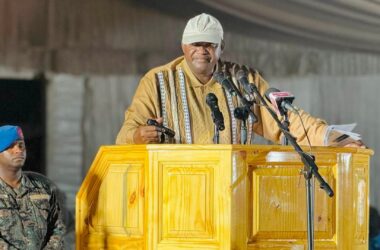

Hon. Tumanding Sanneh, National Assembly Member for Foni Jarrol, has reaffirmed the relevance of the “No Alliance” movement, insisting that its grassroots support remains strong despite political disagreements, organisational challenges and ongoing disputes surrounding the use of the APRC name.
Sanneh made the remarks upon arrival at Pencha Mi Hall, where supporters had gathered for a major “No Alliance” meeting. Pointing to the turnout, the lawmaker said the size of the crowd was itself evidence of the movement’s continued support among Gambians.
“I think before the end of the day, the crowd will answer that,” Sanneh told reporters when asked about the movement’s standing.
“We don’t buy crowds, and there is no AI. People know who we are. People know who we are, even at the National Assembly, and they know what we represent. We represent The Gambia and the interests of Gambians,” he said.
Sanneh also explained the circumstances that led to the emergence of the “No Alliance” movement, particularly disagreements within the APRC over political negotiations and proposed alliances.
According to the Foni Jarrol lawmaker, his faction did not support discussions that, in his view, sought to steer the party towards a particular regional political narrative. He said the disagreements also arose despite what he described as a firm written agreement governing the discussions.
“We did not agree to go into those discussions, nor did we agree that the validity of the discussions should be misinterpreted,” Sanneh said.
He argued that the decision by his faction to withdraw from the negotiations was based on its interpretation of the agreement and its desire to preserve the political identity of its supporters.
“We pulled back legitimately, saying that those who took the party or entered into that alliance, since our position was not officially recognised, that is why we could not join that alliance,” he explained.
Sanneh further alleged that the movement had faced repeated disruptions while attempting to organise meetings and engage supporters across the country.
“During the recent period, whenever we held a meeting or any gathering, they would disperse everyone. Even at public places or inside private homes, they would come and disrupt things,” he claimed.
He said the group has therefore sought to move away from the APRC name and operate under the “No Alliance” identity.
“That is why we have now officially asked for time out, so that the APRC name can be removed and stand as ‘No Alliance,’” Sanneh said.
With the 2026 presidential election approaching, some political observers and supporters have suggested that the movement should abandon the “No Alliance” label and adopt a new identity to avoid confusion among voters.
Sanneh, however, defended the decision to retain the name, arguing that changing the identity at this stage could create greater uncertainty among supporters.
“Some people are saying that we should drop the ‘No Alliance’ name because time is short and the election is very close. But if we leave things as they are right now, our people will become confused. That is why we are maintaining the name ‘No Alliance,’” he said.
The lawmaker also criticised what he described as prolonged political negotiations that have failed to deliver meaningful progress for the country, while expressing confidence that Gambians understand the principles underpinning the movement.
“It belongs to Gambians, but I believe Gambians will feel pity. People can see it clearly from the crowd,” Sanneh said.