
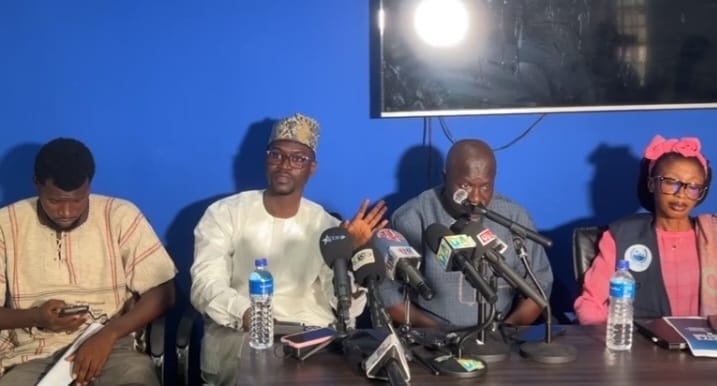




Prominent human rights defender Madi Jobarteh has accused President Adama Barrow’s government of creating an environment of impunity and administrative lawlessness reminiscent of the 22-year rule of former President Yahya Jammeh.
Jobarteh made the remarks during a joint press conference in Banjul attended by civil society organisations, including Gambia Participates, Gambians Against Looted Assets (GaLa), and the Edward Francis Small Centre for Rights and Justice (EFSCRJ).
He called on Gambians to organise peaceful protests across the country and use the courts to challenge what he described as government officials’ disregard for accountability and the law.
“The constitution refers to ‘public servants,’ not ‘public masters,’” Jobarteh said, questioning what he described as the growing tendency among public officials to treat state resources as personal property.
“How can we tolerate civil servants acting with such lawlessness and arrogance, plundering and personalising public resources as if they belong to them?” he asked.
The civil society coalition’s concerns come amid public controversy over the management and alleged secretive disposal of assets linked to the former Jammeh administration. The matter is currently being examined by a Special Select Committee of the National Assembly.
Jobarteh criticised senior government officials, including cabinet ministers, permanent secretaries and judicial authorities, over their alleged failure to provide satisfactory explanations concerning missing documents, financial records and properties whose whereabouts or ownership remain unclear.
He argued that a serious accountability gap exists when senior officials can allegedly escape consequences for negligence or unauthorised decisions involving public assets, while ordinary citizens demanding transparency can face arrest, prosecution and imprisonment.
According to Jobarteh, the problem extends beyond individual cases and reflects deeper weaknesses within The Gambia’s public service.
Six decades after independence, he said, the country’s public institutions continue to struggle with corruption, poor service delivery, bureaucratic arrogance and disregard for established legal procedures.
He further argued that the political transition following Jammeh’s departure in 2017 presented an opportunity to establish stronger and more transparent institutions, but that opportunity has not been fully realised.
Instead, Jobarteh accused the Barrow administration of expanding administrative secrecy and failing to establish the level of institutional accountability expected after the end of Jammeh’s rule.
The activist’s remarks add to growing civil society pressure on the government over the handling of public resources and the conduct of state officials.
He urged Gambians not to remain silent, stressing that citizens have a responsibility to demand transparency and hold public officials accountable through lawful and democratic means.
The coalition’s call for public action comes as scrutiny of the government’s management of state assets intensifies, with questions over documentation, financial accountability and the disposal of properties continuing to generate public concern.
Jobarteh maintained that the protection of democracy requires more than elections, arguing that public institutions must also operate within the law and remain answerable to the citizens they serve.