
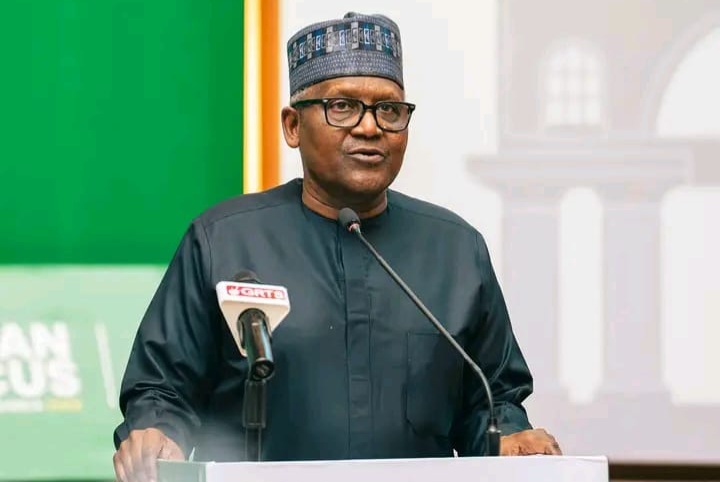



Africa must place industrialisation and manufacturing at the centre of its economic agenda if it hopes to create enough jobs for its rapidly growing youth population, President and Chief Executive of Dangote Industries Limited, Alhaji Aliko Mohammad Dangote, has said.
Speaking at the African Caucus 2026 meeting held at the OIC Conference Center on Tuesday, Dangote urged African governments to accelerate industrial development, strengthen the private sector, and remove obstacles preventing investment in manufacturing.
Addressing policymakers, financial leaders, and development stakeholders, Africa’s richest businessman described industrialisation as the continent’s most effective pathway to sustainable economic transformation, warning that Africa faces an unprecedented employment challenge.
According to Dangote, the continent must create approximately 20 million new jobs every year simply to accommodate the millions of young people entering the labour market annually.
He argued that traditional sectors of the economy can no longer absorb the growing workforce on their own.
“Public sector employment, agriculture, and extractive industries alone cannot meet this demand. Only industrialisation provides the scale, productivity, and multiplier effects required to absorb Africa’s expanding workforce,” Dangote said.
The industrialist noted that while agriculture remains an important pillar of many African economies, manufacturing offers significantly higher productivity and greater opportunities for value creation.
Citing data presented during his address, Dangote said manufacturing jobs typically generate productivity levels three to five times higher than those in traditional agriculture, making the sector critical for boosting incomes and accelerating economic growth.
He also highlighted the sector’s wider economic impact, explaining that manufacturing creates employment far beyond factory gates.
“For every direct manufacturing job created, an additional five to six jobs are generated across supporting industries, including logistics, transport, services, packaging, and supply chains,” he said.
Drawing on his decades of experience building one of Africa’s largest industrial conglomerates, Dangote called on governments across the continent to adopt policies that encourage long-term private sector investment, improve infrastructure, reduce regulatory bottlenecks, and support local industries.
He stressed that creating an enabling business environment would unlock industrial growth, strengthen regional value chains, reduce dependence on imports, and position African economies for long-term prosperity.
Dangote’s remarks received strong support from participants at the African Caucus 2026, reinforcing a growing consensus among policymakers and business leaders that industrialisation and value addition are indispensable to Africa’s development agenda.
Analysts at the meeting noted that with Africa expected to account for a significant share of global population growth over the coming decades, expanding manufacturing capacity will be essential to tackling unemployment, reducing poverty, and improving economic resilience.
The African Caucus serves as an important platform for finance ministers, central bank governors, and development partners to discuss economic priorities and strengthen cooperation on policies aimed at promoting sustainable growth across the continent.