
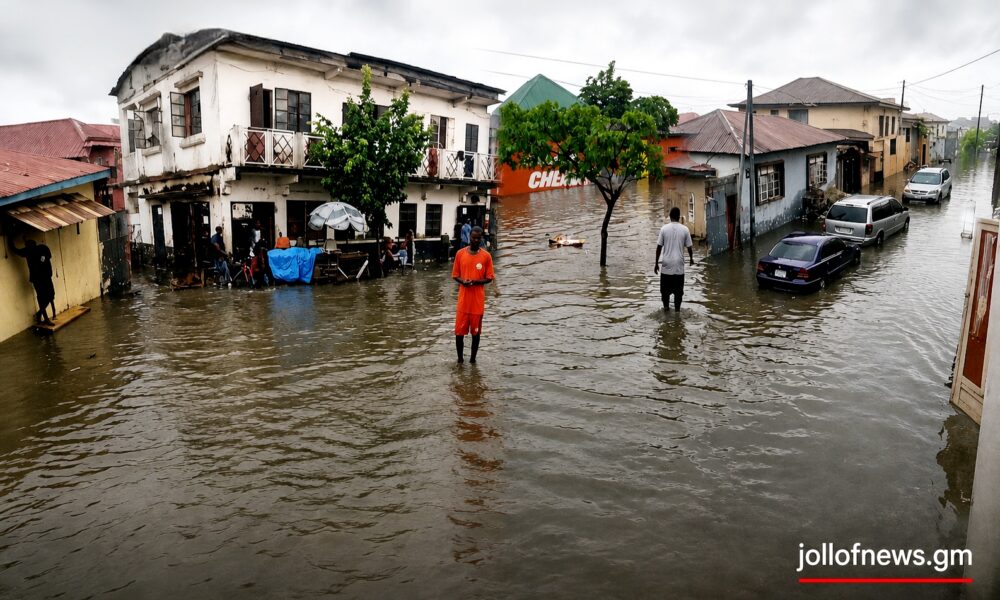




Environmental activist Amadou Worry Jallow has blamed poor waste management, weak enforcement of municipal regulations and inadequate maintenance of drainage infrastructure for the flooding that affected parts of Banjul following heavy rainfall on Wednesday evening.
Speaking to JollofNews, Jallow said the flooding, which inundated several streets, homes and businesses, highlights long-standing problems in the capital’s drainage system.
“Any level of flooding should be a concern,” he said, warning that even relatively shallow floodwater can damage property, disrupt businesses and pose health and safety risks.
Jallow said indiscriminate disposal of waste by residents and street vendors remains one of the principal causes of blocked drains. According to him, plastic bags, paper, clothing and other rubbish are washed into drainage channels during heavy rains, preventing stormwater from flowing freely.
He also criticised the Banjul City Council (BCC), alleging that municipal authorities have not effectively enforced existing sanitation regulations or maintained critical drainage infrastructure.
Jallow specifically pointed to the council’s Department of Planning, which oversees the Waste Management and Works and Services departments, arguing that it has failed to ensure proper coordination and maintenance of the city’s drainage network.
He further alleged that the Works and Services Department has not taken sufficient action against property owners who dump construction sand on public roads and over drainage channels.
“The central drainage lines and grates running through Banjul are frequently blocked by waste and accumulated sand,” Jallow told JollofNews. “When those channels become blocked, rainwater cannot enter the drainage network. Instead, it collects on the roads before flowing into homes and businesses.”
During visits to affected areas, Jallow said several residential compounds and commercial properties had been flooded, particularly around Primet Street near Gambia High School.
Shop owners in the area were seen removing water from their premises in an effort to protect their goods after floodwater entered their businesses.
“Where there is no passage through the drainage network, the water flows directly into people’s compounds. Water must have somewhere to go. If it cannot flow away, it will accumulate,” he said.
To reduce future flooding, Jallow called for stricter enforcement of the Anti-Littering Act and stronger municipal by-laws governing waste disposal.
He said food vendors and street traders operating in public spaces should be required to provide waste bins, while the BCC’s Works and Services Department should carry out regular clearing of sand, silt and debris from major drainage channels.
Jallow warned that unless authorities improve enforcement of waste management laws and undertake routine maintenance of drainage infrastructure, Banjul is likely to continue experiencing avoidable flooding during the rainy season.
The flooding followed heavy rainfall that affected several parts of the capital on Wednesday evening, with water entering homes, businesses and low-lying areas.