
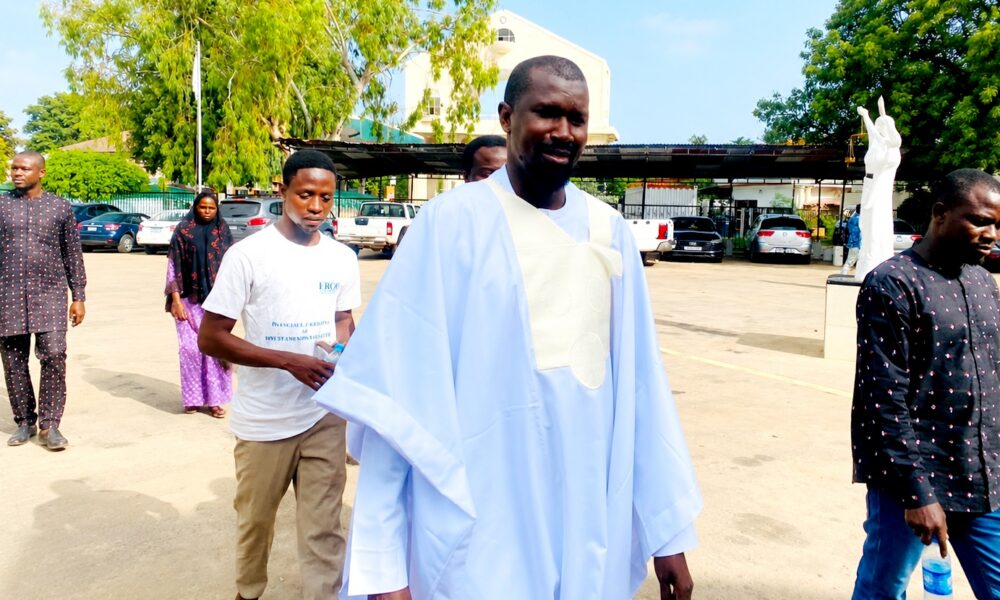



The Supreme Court of The Gambia has unanimously declared the removal of former Auditor General Modou Ceesay from office in September 2025 unlawful and unconstitutional, awarding him D4 million in vindicatory damages for the violation of his constitutional rights.
In a landmark judgment delivered on Tuesday, Justice O.M.M. Njie, presiding over a five-member panel of the apex court, held that the actions taken by the executive and the police to forcibly remove Ceesay from his office contravened Section 158 of the Constitution and the provisions of the National Audit Act.
The court ruled that the police operation to eject Ceesay from the National Audit Office was unlawful, null and void, and had no legal effect.
The decision marks a significant affirmation of constitutional safeguards governing the independence of constitutional office holders and underscores the limits of executive authority in matters protected by the Constitution.
No Reinstatement Despite Constitutional Violation
Although the court found that Ceesay’s removal was unconstitutional, it declined to order his reinstatement as Auditor General.
Justice Njie observed that while the court possesses the discretion to order reinstatement in appropriate circumstances, Ceesay had not specifically sought that relief in his application. The court further noted that the relationship between the former Auditor General and the executive had deteriorated to such an extent that reinstatement would not serve the public interest.
Given the constitutional responsibilities of the Auditor General’s office, which require continuous engagement with the executive branch, the justices concluded that restoring Ceesay to office would be impractical and potentially disruptive to the effective functioning of the institution.
Consequently, the current Auditor General, Cherno Amadou Sowe, will remain in office.
Court Orders Comprehensive Financial Compensation
While declining reinstatement, the Supreme Court ordered extensive financial remedies designed to restore Ceesay to the position he would have occupied had he not been unlawfully removed.
The court ordered the Attorney General and the Inspector General of Police to jointly pay Ceesay D4 million in vindicatory damages within 60 days for the breach of his constitutional rights.
In addition, the state was directed to pay all outstanding salaries and allowances from the date of Ceesay’s removal in September 2025 up to the date of the judgment, together with interest at the rate of 10 percent.
The Attorney General was also ordered to ensure payment of Ceesay’s full salary and allowances from the date of the judgment until the date his original tenure would have expired or until his retirement date, whichever is applicable.
The court further directed that all pension benefits and gratuity owed to Ceesay be properly calculated and paid within 60 days.
Parties Given Seven Days to File Financial Records
To facilitate the implementation of its orders, the Supreme Court instructed the parties to file affidavits and supporting documentation within seven days.
The documents are expected to provide verified information regarding Ceesay’s age, salary, allowances, pension entitlements and gratuity benefits to enable the court to determine the state’s total financial liability arising from the judgment.
Significant Constitutional Ruling
The judgment represents one of the most consequential constitutional decisions concerning the independence of public institutions in recent years.
By declaring the former Auditor General’s removal unconstitutional and awarding substantial damages, the Supreme Court reaffirmed that constitutional office holders are entitled to the protections guaranteed under the Constitution and cannot be removed through executive action outside the legal procedures prescribed by law.
Although Ceesay will not return to office, the ruling provides comprehensive legal vindication and establishes an important judicial precedent on the constitutional limits of executive power and the protection of independent state institutions.